American Financial Group
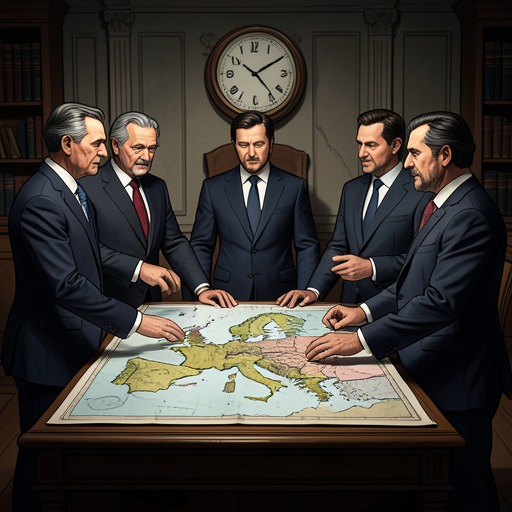
The Secret of ChimneysThe American group of financiers is a prospective foreign backer in the struggle over the Herzoslovakian throne. Its approach to Prince Nicholas turns a disputed succession into a competition over oil concessions: while the British Government and Herman Isaacstein’s interests are aligned with Prince Michael, the American group is prepared to finance his cousin instead. The arrangement exposes the material stakes behind the royalist negotiations and helps explain why Nicholas’s presumed death and subsequent return matter to more than the dynasty itself.
Political and Financial Background
The group enters a country whose monarchy has already been violently displaced. King Nicholas IV married Queen Varaga, whose claimed royal lineage and ascent to the throne were contested; the resulting public discontent culminated in an uprising that killed the king and queen and established a republic. Years later, the possibility of restoring the monarchy brings foreign governments and financiers into Herzoslovakia’s unresolved political future.
The British-backed proposal centers on Prince Michael. He had pledged, if restored to the throne, to grant oil concessions to companies in which Isaacstein was interested. The British Government was prepared to support his claim because of his pronounced British sympathies, while Isaacstein sought a loan arrangement that would help place him on the throne. Thus the prospective American intervention is not a separate commercial question: it contests the same link between political recognition, royal power, financing, and access to oil.
Approach to Prince Nicholas
The American group had made overtures to Prince Nicholas, Michael’s first cousin and the likely next heir if Michael were removed. At the time of the negotiations, Nicholas was in America. His history made him a plausible rival claimant: he had been known for democratic views and associations with Socialists and Republicans, and had reappeared after a report of his death in the Congo had circulated. The account of his American appearance connects the group’s interest in him directly to the succession contest.
In return for financial support, Nicholas represented that Herzoslovakians would prefer him to Michael because he was more sympathetic to modern, enlightened ideas. He invoked his early democratic views and sympathy for republican ideals, offering the American financiers a political case for backing him alongside the commercial prospect of concessions. The pitch therefore combined a claim about popular preference with a promise concerning investment returns; the evidence does not establish that the group secured an agreement or received the concessions.
Rival Claims and the Deal’s Exposure
The group’s overture is disclosed during Superintendent Battle’s examination of the competing interests surrounding Michael’s death. Battle infers that Michael wanted money, Isaacstein wanted oil, and the British Government was prepared to support Michael. When Battle asks whether anyone else sought the concessions, the reply identifies the American group and suggests that its approach to Nicholas had been turned down at that stage. Isaacstein confirms the connection to oil, bringing the two rival financial alignments into view.
Battle’s reconstruction makes the group’s significance conditional but substantial. The Loyalist party supported Michael, while the Americans had approached Nicholas; the group’s prospective financing could have strengthened a competing claimant and redirected the promised oil concessions. The political bargain is further destabilized when Michael is murdered and the question of the next heir becomes urgent. Nicholas, assumed dead by some of those involved, is then the claimant whose availability could revive the American arrangement.
Nicholas’s Identity and the Unresolved Outcome
The group’s investment calculation depends on Nicholas’s identity and survival. In the closing disclosure, Anthony Cade tells Isaacstein that the report of Nicholas’s death was deliberately spread and reveals that he is Nicholas himself, explaining that he had left the Congo under the name Anthony Cade. This revelation changes the status of the American overture: its intended claimant was not merely a rumored figure abroad but the man Isaacstein is addressing.
The disclosed identity does not, in the available evidence, establish that the American group ultimately financed Nicholas or obtained oil concessions. It does show how the group’s proposal fits the larger succession crisis: a supposedly absent heir could be presented as a viable alternative to Michael, and financial support could be exchanged for rights to a resource whose development depended on who held the crown. The group’s role is therefore less that of a governing institution than that of an external economic power whose offer helps reveal the stakes and competing alliances behind the restoration negotiations.